
Hardee County Court Records After a Jail Arrest
An arrest is only the first step. After someone is booked into the Hardee County jail, the Office of the State Attorney for the Tenth Judicial Circuit reviews the arrest and the law enforcement reports, then files formal charges in court. That filing is what opens the case and creates the court record. The charges on the jail arrest log are booking charges, and the prosecutor can file, change, reduce, add, or drop charges when the formal case begins.
It helps to keep the two sides apart. The booking and custody side lives on the jail arrest log, covered on the jail inmate records page, and booking photos are explained on the jail roster mugshots page. The court record itself is the set of charges the prosecutor filed and everything that happens to them as the case moves. That is the record this page helps you find after an arrest.
How to Find Hardee County Court Records After an Arrest
Court charges and their status are tracked in the county's online court-record system, hosted on the CiviTek OCRS portal for Hardee County. The portal landing page offers public anonymous access along with attorney, registered user, and party access that require credentials. The jail arrest log shows booking detail, while OCRS shows the court case once charges are filed.
- Open the Hardee County OCRS court-record portal and choose the public access option.
- Search by the defendant's name or by a case number if you have one.
- Open the case and read the list of filed charges.
- Check each charge's level and current status, and note any hearings or dispositions on the docket.
If a record cannot be found online, the Clerk of Courts can help in person or by phone at 417 West Main Street, Suite 202, Wauchula, FL 33873, (863) 773-4174, Monday through Friday from 8:30 a.m. to 4:00 p.m. The screenshot below shows the OCRS landing page and its access choices. The live page is the Hardee County OCRS portal.
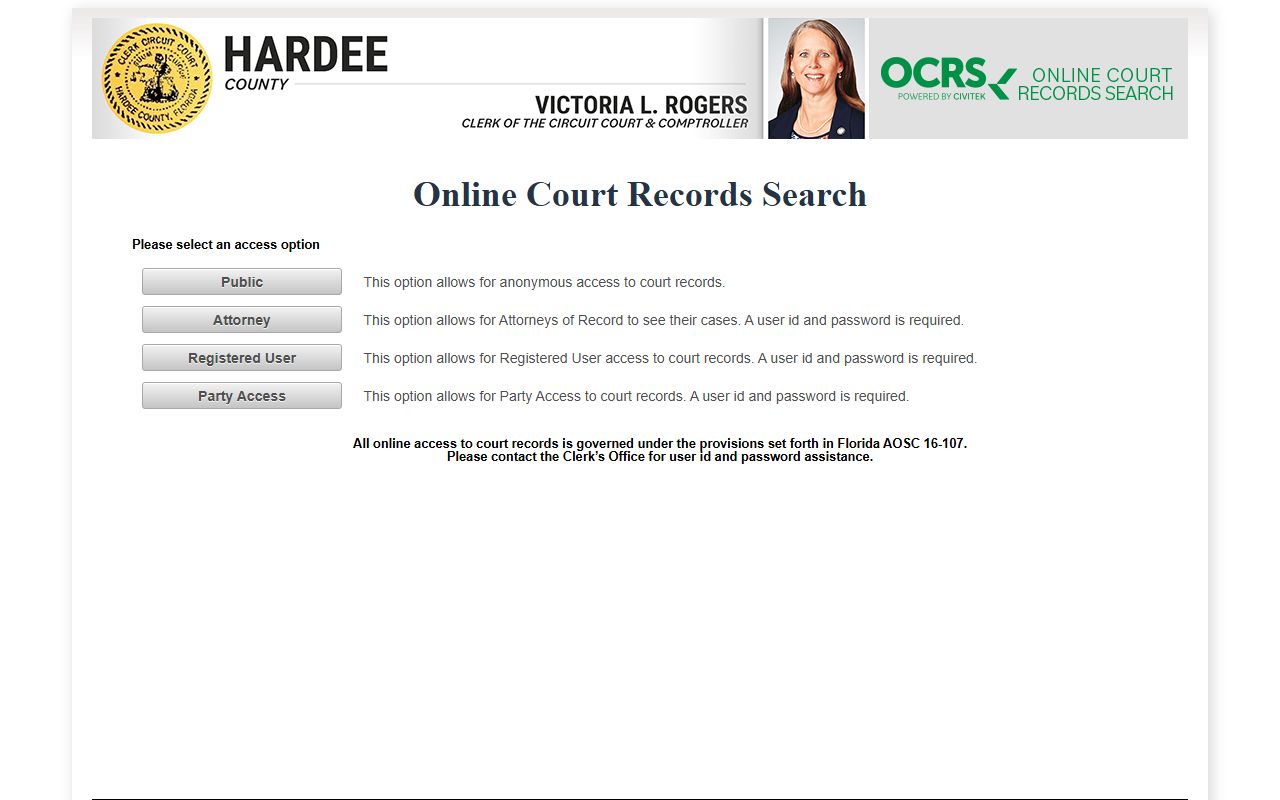
All online access is governed by Florida Supreme Court order AOSC 16-107, and the Clerk's office issues the user IDs and passwords for the higher-access roles.
Who Can See Court Records After an Arrest
The OCRS portal does not treat every user the same. Public access is anonymous and broad, while attorney, registered, and party access open more documents but require a credentialed account and an agreement. The table sets out the four paths.
| Access Option | Login | Notes |
|---|---|---|
| Public | None shown on landing page | Anonymous access to court records. |
| Attorney | User ID and password | For attorneys of record; contact the Clerk for help. |
| Registered User | User ID and password | Requires a registration agreement. |
| Party Access | User ID and password | For parties; agreement may need a case number and party PIN. |
The registered-user agreement asks for the registrant's name, email, address, phone, a bar number for attorneys, and a notarized signature, and the Clerk may limit what is viewable online.
How Charges Get Filed After an Arrest
The court record begins when a charging document is filed. In Florida, the document depends on the offense. A complaint or citation often starts a misdemeanor or criminal-traffic case. A prosecutor files an information for most felonies. A grand jury returns an indictment for the most serious felonies, such as a capital case. The Clerk's criminal division defines a felony as an offense punishable by death or imprisonment in a state prison, and a misdemeanor as one punishable by up to one year in county jail.
| Complaint | Information | Indictment | |
|---|---|---|---|
| Filed By | Officer / Prosecutor | State Attorney | Grand Jury |
| Common For | Misdemeanors, criminal traffic | Most felonies | Capital and top felonies |
| Starts | The case | The case | The case |
The Prosecutor Behind a Hardee County Court Record
Florida does not use the title district attorney. The prosecutor here is the Office of the State Attorney for the Tenth Judicial Circuit, which serves Hardee, Highlands, and Polk Counties. After an arrest, that office reviews the law enforcement reports and decides what to file, which is the step that turns booking charges into a formal court record. The decision can mean filing the same charges, filing different ones, or declining to file at all.
The Clerk's criminal division sorts those filings into felony, misdemeanor, and criminal-traffic cases. Felonies break into five levels, from third-degree up to capital. Misdemeanors and criminal-traffic offenses carry up to a year in county jail, and the Clerk warns that missing a criminal-traffic court date can bring a delinquency fee, a license suspension, and a capias. Each category has its own contact email at the Clerk's office for case questions.
Charge Status in the Court Record
Charges are not fixed once a case opens. A prosecutor can amend or reduce a charge, add a count, or drop one entirely, and the booking charges on the jail arrest log can differ from the charges finally filed. Reading the court record means understanding the common status terms, which appear on the docket as the case moves.
| Status | What It Means |
|---|---|
| Pending | The charge is filed and the case is still open. |
| Amended / Reduced | The charge was changed or lowered from the original. |
| Dismissed | The charge was dropped and will not proceed. |
| Nolle Prosequi | The prosecutor chose not to pursue the charge. |
Bond and Release After an Arrest
Bond connects the jail side and the court side. Soon after booking, bond information becomes available, and the Sheriff says it can be confirmed through the detention control room within one to two hours of the officer's arrival. The county's sample arrest log shows bond set per charge, with types such as Cash Or Surety and Bondsman. A judge can also order release at first appearance, and a hold from another agency can keep a person in custody even when a bond exists.
| Bond Type | How It Works |
|---|---|
| Cash Bond | Money paid directly, if accepted under the bond order. |
| Surety / Bondsman | A licensed bail agent posts the bond for a fee. |
| Judge Release | A judge can release a person at first appearance. |
| No-Bond Hold | A court order or outside-agency hold blocks ordinary release. |
Note: a bond amount on the arrest log does not guarantee release, because a separate hold or court order can still keep a person in custody.
Warrants That Lead to an Arrest
Some arrests start with a warrant rather than a fresh incident. An arrest warrant or a bench warrant for failure to appear can bring a person into the Hardee County jail. The Sheriff's office does not expose a public online warrant list, so the practical routes are the Sheriff's main line at (863) 773-0304, the Clerk for a court case, and a public records request for non-exempt warrant-related records. The Clerk's criminal-traffic page warns that failure to appear can lead to a delinquency fee, a license suspension, and a capias.
Charges vs. Convictions
An arrest and a filed charge are accusations, not proof of guilt. A conviction requires a plea or a verdict, held to a much higher standard. Both the charge and the conviction are public, but they mean different things in a court record.
| Charge | Conviction | |
|---|---|---|
| Stage | Accusation | Verdict or plea |
| Burden of Proof | Probable cause | Beyond a reasonable doubt |
| Public Record | Yes | Yes |
Sealed vs. Expunged Records After an Arrest
Florida lets some people clear an arrest record after a dismissal or an eligible outcome. The Hardee Clerk's expunge and seal page explains the local version, drawing on the state's criminal-history rules. Sealing hides a record from public view, while expunction goes further and treats the record as if it never existed for most purposes. Eligibility depends on the charge and the disposition.
| Sealed | Expunged | |
|---|---|---|
| Visibility | Hidden from the public | Treated as if it never existed |
| Law Enforcement | Limited access | Very limited access |
| Eligibility | Depends on charge and outcome under Florida law | Often after a dismissal or no conviction |
Background Check Considerations
Court records pulled casually online are not the same as a regulated background check. A formal background screening for employment or housing must follow the federal Fair Credit Reporting Act, while a public court-record lookup does not.
Important: This site is not a consumer reporting agency under the FCRA, and nothing here may be used to screen for employment, housing, credit, or insurance.
Older Court Records and Copy Fees
Not every court record is recent, and the Clerk keeps a deep archive. Official records kept by the Clerk's office can be viewed by the public unless they are sealed or expunged, and Hardee County official records are available on the Clerk website from January 14, 1981 forward, with images for that full span. For a paper or certified copy, the Clerk charges $1.00 per page, plus $2.00 per document for certification. Requests for redaction of protected personal information have their own posted forms.
When a record is too old for the online portal or needs to be certified for another agency, the Clerk's office handles it directly. The official records team can be reached by email or by phone through the Clerk's main line, and the courthouse is open on weekdays for in-person help.
Restricted Court Records After an Arrest in Hardee County
Not every record tied to an arrest is open. Juvenile cases are treated differently under Florida's juvenile justice chapter. Sealed or expunged charges are withheld from public view, and certain dismissed matters may be restricted. The Clerk can also redact protected personal information and the identifying details of victims of trafficking or sexual offenses. When a record is not visible online, the Clerk's office is the place to ask what is available and how to request it.